Despite Nigeria’s modest economic growth in the first quarter of 2026, experts have raised concerns over the weak performance of the manufacturing sector, warning that the economy may struggle to achieve sustainable transformation without a stronger industrial base.
Chief Executive Officer of the Centre for the Promotion of Private Enterprise, CPPE, Dr Muda Yusuf, gave the warning in a policy brief on the Q1 2026 Gross Domestic Product, GDP, report released by the National Bureau of Statistics, NBS.
According to the NBS report, Nigeria’s real GDP grew by 3.89 per cent year-on-year in Q1 2026, compared to 3.13 per cent recorded in the corresponding period of 2025.
Yusuf said the latest figures reflected improving macroeconomic stability and resilience on trade and services, but noted that the weak contribution of manufacturing and the sharp contraction in electricity supply remained major structural concerns for the economy.
He noted that the manufacturing sector recorded a modest growth of 3.29 per cent, an improvement from the 1.13 per cent growth recorded in the fourth quarter of 2025, driven largely by petroleum refining, food and beverages, cement, chemicals and pharmaceuticals.
However, he stressed that manufacturing contribution to GDP remained below 10 per cent, underscoring persistent structural challenges confronting the industrial sector.
According to him, high energy costs, elevated interest rates, poor infrastructure, logistics bottlenecks and policy uncertainties continue to weaken industrial productivity and competitiveness.
“The economy cannot achieve durable structural transformation without a stronger manufacturing base. Industrialisation remains the most sustainable pathway to large-scale job creation, export competitiveness and inclusive growth,” Yusuf stated.
He also expressed concern over the prolonged crisis in the textile industry, describing it as evidence of worsening de-industrialisation and the erosion of Nigeria’s domestic productive capacity.
“The decline of labour-intensive industries such as textiles has serious implications for employment, household incomes, industrial linkages and poverty reduction,” he added.
The CPPE boss further identified what he described as a major structural imbalance in the economy, noting that while the non-oil sector contributes about 96.08 per cent of GDP, it accounts for less than 15 per cent of foreign exchange earnings due to weak export competitiveness and limited integration into global value chains.
Business News of Friday, 29 May 2026
Source: www.vanguardngr.com
Weak manufacturing base threatens Nigeria’s economy — CPPE
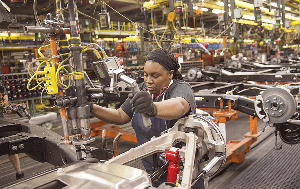 The photo used to illustrate the story