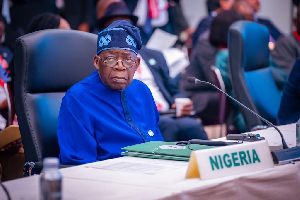
London-based The Economist has argued that President Bola Tinubu could secure a second term in the January 2027 presidential election, despite being broadly unpopular among Nigerians.
In an article titled "Nigerians Dislike Their President, But May Re-elect Him Anyway," the magazine pointed to what it described as Nigeria's "complicated electoral dynamics" as the key reason the incumbent retained a plausible path to victory. These included political cynicism, a divided opposition, religious identity, incumbency advantages and historically low voter turnout in insecurity-hit areas.
The publication noted that Tinubu returned from Paris on Tuesday, September 29, after spending about a month in Europe, having extended what it described as a "working holiday" by several days. Despite the country's security and economic difficulties, the magazine said the President appeared notably relaxed about his re-election prospects.
The magazine described an insurgency in Borno state that has lasted two decades, with jihadist factions generating income through kidnapping, extortion and farm looting. It quoted a 27-year-old Maiduguri resident who said he had to travel to Chad to sell grain because local buyers could no longer afford it. The publication said voter turnout in Borno fell below 20 per cent in the 2023 election, against a national average of 27 per cent.
On economics, it acknowledged that Tinubu's reforms had been "lauded by investors" but said they had not yet improved daily life for most of the country's 240 million people. Annual inflation in August remained around 15 per cent, with food inflation closer to 20 per cent.
Regarding the opposition, the publication noted that Atiku Abubakar of the ADC and Peter Obi of the NDC had not formed a joint ticket, which it said risked splitting the anti-APC vote. Analyst Joachim MacEbong of Control Risks was quoted saying: "Because it's not a united ticket, that anti-APC vote is not coalesced into a single vote."
2027 Election: ADC and NDC Reject The Economist's Prediction
The ADC's national publicity secretary, Mallam Bolaji Abdullahi, said the cost-of-living crisis, rather than religion or ethnicity, would drive voting decisions, ThisDay reported.
"Nigerians across all divides are united under the cost-of-living crisis that the Tinubu administration has plunged them into," he said, adding that the only route to an APC victory was electoral manipulation.
The NDC's national publicity secretary, Osa Director, questioned how the publication could catalogue the President's weaknesses and still conclude he would win.
"The Economist article agreed that Tinubu is so unpopular. So, how did it arrive at the conclusion that he would still win in spite of that?" the party said. The NDC maintained that there was no legitimate pathway to Tinubu's re-election.
Presidency Defends Tinubu's Economic Reforms
Presidential spokesperson Bayo Onanuga, posting on his verified X account @aonanuga1956, defended the administration's track record by drawing on Tinubu's October 1 Independence Day address. He said previous governments had treated symptoms rather than underlying structural problems. Onanuga quoted Tinubu directly:
"Our reforms did not create the weaknesses in our economy. They confronted them." The president said Nigeria's economy grew by more than four per cent this year, with both oil and non-oil sectors contributing to what he called a renewed period of stable growth.
Some immutable truths from President Tinubu's October I speech (1)
— Bayo Onanuga, OON, CON (@aonanuga1956) October 2, 2026
The politicians criticising President Tinubu's October 1 speech apparently hadn't read it. They seemed to have prepared their reactions before the speech was delivered on network TV and radio.
Here is one… pic.twitter.com/DB0M0NDmHx