The late legendary musician, Orlando Julius, revealed in an old interview how the late Premier of the defunct Western Region of Nigeria, Chief Obafemi Awolowo, laid the groundwork for the creation of Afrobeat, which has metamorphosed into the global genre Afrobeats.
In the interview, Orlando Julius, who founded Afrobeat, said Awolowo established a centre in Ibadan with musical instruments to serve about 30 bands.
He said he and many other popular musicians of his time all studied music at the centre, from which he created Afrobeat genre.
He said, “When my dad died, I dropped out of high school and left Ekiti for Ibadan when Obafemi Awolowo was the Premier of Western Nigeria. around 1956. I devoted my full interest in music in 1957 because Obafemi Awolowo was a music lover who also loved his hometown. Despite establishing free education, he didn’t have the chance to ensure music was taught in school, unlike his friend in Ghana, Nkrumah, who ensured it was taught from primary school onwards, and if you didn’t take music, you would fail.
“At the time, Awolowo thought of what to do. So, he called the Action Group and suggested they buy a lot of musical instruments that could be enough for about 30 bands. He said, regardless of your extraction, you were free to come here to learn. That was where I learnt music and where I learnt my first instrument. Though I was already playing some drums while in school, I learnt music instruments professionally at the place where Awolowo placed those instruments for public consumption. It was at the place I learnt how to play alto sax, saxophone, and drumset. I play drums very well and also guitar. I’m glad that man (Awolowo) established that platform. Many of us who learnt music at the place at the time, if you check all the bands that became popular today, most of their members studied at the establishment.
“I played with Eddy Okonta for just a year in 1958, after which I established my own band. That was how Afrobeat started. The Ekiti and Ijesha music I used to sing while in high school, they fell on minor notes. So, I arranged those songs and rehearsed with my band. Before I recorded, I called some boys who were my friends. My brother, I.K Dairo, said I should come to Ilesha, that he had band instruments. That was close to the end of 1960. So, in early 61, I started rehearsing.”
He said at the time, I.K. Dairo had so many shows he was booked for and had to allow him and his new band to play at some of them. He said his band was named I.K Dairo Globetrotters.
“When we started playing in Ibadan, the crowd that attended our shows, including white people, always marvelled at our brand of music. Our high-life music was different. Whenever people asked what kind of music we were playing, I always told them it was Afrobeat. The reason I called it Afrobeat was that, by then, apart from the minor notes I use in my music, I listened to Cuban music, Caribbean music, Kenyan music, South African music, and others. So, I put them all together. That is where Afro comes from. Afro is African, and those people are descendants. That’s how Afrobeat started,” he said.
Orlando Julius then spoke of how he influenced Fela and the support he gave to him after the latter returned from London.
“He came back from abroad, where he went to study music. He could play the trumpet and read, write, and arrange music. At the time, he was working as a DJ at NBC in Lagos. Then, Ibadan was the Mecca of music because of WNTV and WNBS. Many came from far and wide, and also from Ghana and other countries, to Ibadan because it had the first television in Africa – WNTV. We were in Ibadan at the time, and our music was one of a kind. Fela came back in 1964, and around 65, he started coming to Ibadan. He was running a course at NBC Ibadan, so he had to come to Ibadan every week. My band played at Independence Hotel at Oke Bola every night, except Mondays, which was our day off. We always had guests, and we charged 10 Shillings. A lot of graduates and undergraduates of the University of Ibadan used to come there, and that was how I was able to meet Tunji Oyelana and Wole Soyinka, who was a lecturer at the University of Ibadan. Tunji was a student and was in the drama department, and Wole Soyinka was their teacher.
“Every time Fela came, he always played trumpet on our stage. I always brought him to my stage to play the trumpet as a guest artist, and people loved it. He liked my band, which was his favourite at the time. When it was time for him to start his own band called Koola Lobitos, I released three members of my band to follow him to Lagos. One played konga; his name is Isiaka Adio. One played trumpet – Eddy Fayehun, who is now a chief in Akure; and one was a bassist – Ojo Ikeji. They started the band in Lagos with him. I had more musicians who were playing with me.
“If you bought Fela Fanta, he won’t be able to drink half of the bottle. He never used to smoke then. When he started his band, Koola Lobitos, the music they were playing then was not my music brand but jazz high-life. He was playing popular highlife songs by different bands that were making it at the time. What he did was rearrange them and add jazz. So, he did jazz highlife. We were the only ones playing Afrobeat,” he said.
ASA
Entertainment of Monday, 26 January 2026
Source: www.mynigeria.com
THROWBACK: What Awolowo did that led to the creation of Afrobeat - Orlando Julius
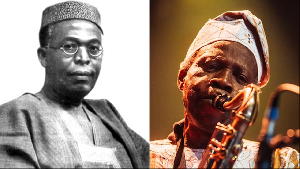 Obafemi Awolowo and Orlando Julius




Opinions