Nigeria’s financial system is receiving global attention following the decision to name the Central Bank of Nigeria as the Central Bank of the Year 2026 in London. The award comes at a time when the country is working to stabilise its economy after years of uncertainty and policy challenges. For many observers, it is a sign that recent reforms under the leadership of Olayemi Cardoso are beginning to restore confidence, strengthen institutions and reposition Nigeria as a more reliable destination for investment.
The award was announced as part of the 13th annual Central Banking Awards, which celebrate excellence among central banks across the world. This year’s recognition came at a time when many economies are still struggling with high inflation, currency pressures and rapid changes in financial technology.
For Nigeria, the award marks a turning point. It reflects a period in which the apex bank, under the leadership of Olayemi Cardoso, has taken deliberate steps to restore stability, rebuild trust and reposition the economy for sustainable growth.
According to the organisers of the awards, the Nigerian central bank stood out for reversing years of unconventional monetary practices and introducing reforms that are now helping to restore both investor and public confidence.
Since assuming office, Cardoso and his team have moved quickly to end practices such as excessive monetary financing, where the central bank previously supported government spending in ways that contributed to inflation and weakened confidence in the financial system.
Instead, the bank has adopted tighter monetary policies aimed at controlling inflation and stabilising the naira. At the same time, it has introduced reforms in the foreign exchange market, including clearing billions of dollars in outstanding obligations that had created uncertainty for investors and businesses.
These actions, according to analysts, have helped to rebuild trust in Nigeria’s financial system, which had been under pressure for years.
Chairman of the Central Banking Awards Committee, Christopher Jeffery, said the Nigerian central bank showed strong leadership during a difficult period.
“The CBN’s leadership team has demonstrated plenty of courage and the CBN showed significant institutional strength to facilitate the rebuilding of unencumbered FX reserves and declining inflation, facilitating measurable progress toward sustainable growth and enhanced financial inclusion,” he said.
The recognition also points to improvements in governance and transparency within the apex bank. Over the past year, the institution has taken steps to streamline its operations, reduce unnecessary costs and improve communication with the public and investors.
Reforms in the banking sector, including recapitalisation efforts, have also strengthened financial institutions, making them better able to support economic growth.
Another area that contributed to the award is the modernisation of Nigeria’s payments system. The central bank has been working on new frameworks to improve digital payments, encourage innovation and expand financial inclusion.
These efforts are particularly important in a country where millions of people still lack access to formal banking services. By improving payment systems and supporting fintech innovation, the CBN aims to bring more Nigerians into the financial system.
The bank’s progress in addressing issues raised by the Financial Action Task Force, including its removal from the grey list, also played a role in boosting Nigeria’s reputation in the global financial community.
Taken together, these reforms have started to change how investors view Nigeria. There is now growing confidence that the country is on a more stable and predictable economic path.
This confidence was evident during recent engagements with global investors in London, where Cardoso explained the direction of the reforms and their impact on the economy.
Speaking on the sidelines of President Bola Ahmed Tinubu’s State Visit to the United Kingdom, he said Nigeria is now better positioned to handle external shocks.
“We have created stronger capacity to withstand shocks,” he said, adding that the central bank is working to ensure that its policies are clear, consistent and predictable.
According to him, the bank is reviewing its policy framework to reduce uncertainty and make it easier for investors to plan.
“We are reviewing our policies with a view to developing meaningful policies and establishing a predictable policy framework to minimise discretion,” Cardoso said.
This shift towards predictability is seen as a key factor in restoring investor confidence. In the past, sudden policy changes often created uncertainty, making it difficult for businesses to operate.
The reforms in the foreign exchange market are another major area of progress. For years, Nigeria struggled with multiple exchange rates, limited access to foreign currency and a backlog of unmet obligations.
These challenges discouraged investment and disrupted business activities.
Under the current leadership, the central bank has taken steps to unify the exchange rate, improve transparency and increase liquidity in the market.
Cardoso said a new foreign exchange manual has removed several restrictions and made it easier for businesses and investors to operate.
There has also been progress in clearing outstanding foreign exchange obligations, which had been a major concern for international investors.
By addressing these issues, the central bank has helped to restore confidence in the foreign exchange market and improve Nigeria’s attractiveness as an investment destination.
Inflation, which had been a major challenge, is also showing signs of improvement.
Cardoso said inflation has started to decline as a result of tighter monetary policies and better coordination with fiscal authorities.
“We will continue to maintain stability, not only on inflation, but in the FX market, with more transparency and consistent reporting,” he said.
He added that the central bank remains vigilant and ready to take further action if needed to keep inflation under control.
Another important development is the growth in Nigeria’s foreign reserves, which have risen to over $50 billion.
Stronger reserves provide a buffer against external shocks, such as changes in global oil prices or financial market volatility.
They also give the central bank more ability to stabilise the currency and support the economy during difficult times.
The award reflects the central bank’s efforts to strengthen financial inclusion.
Through its digital finance initiatives, the CBN is working with fintech companies to remove barriers and expand access to financial services.
Cardoso said the bank is committed to supporting innovation while ensuring that the financial system remains stable and secure.
The upcoming launch of a new Payments System Vision is expected to further improve digital payments and position Nigeria as a leader in cross-border transactions in Africa.
This is particularly important as digital finance continues to grow rapidly across the continent.
By building a strong and inclusive financial system, Nigeria can unlock new opportunities for economic growth and development.
The recognition of the CBN also comes at a time when Nigeria is seeking to attract more investment.
With improved stability, clearer policies and stronger institutions, the country is becoming more appealing to both local and international investors.
Cardoso said the reforms have moved Nigeria from a period of stabilisation to one focused on growth and investment.
He urged investors to see Nigeria as a country with strong potential and expanding opportunities.
According to him, “Nigeria is an economy to watch very closely” as its banking system strengthens and its growth drivers continue to develop.
For ordinary Nigerians, the impact of these reforms may take time to fully materialise, but there are already signs of progress.
A more stable exchange rate can help reduce the cost of imported goods, while lower inflation can improve purchasing power.
Stronger banks can provide more loans to businesses, supporting job creation and economic activity.
At the same time, improved financial inclusion can give more people access to savings, credit and payment services, helping them to participate more fully in the economy.
However, experts say it is important to sustain these reforms to ensure long-term success.
Maintaining discipline in monetary policy, improving coordination with fiscal authorities and continuing to strengthen institutions will be key to building on the progress made so far.
The Central Banking Award is therefore not just a recognition of past achievements, but also a reminder of the work that still needs to be done.
It shows that Nigeria is moving in the right direction, but also that consistency and commitment will be needed to achieve lasting economic stability and growth.
For the Central Bank of Nigeria, the award is a sign that its efforts are being recognised globally. For the country as a whole, it is an indication that the reforms are beginning to deliver results and restore confidence in the economy.
As Nigeria continues on this path, the focus will be on ensuring that the benefits of these reforms are felt by all citizens, creating a more stable, inclusive and prosperous future.
What the expert says
Dr. Wahab Balogun, Managing Director and Chief Executive Officer of Ambosit Capital Managers in his intervention stated that “this award for the Central Bank of Nigeria is more than just recognition—it sends a strong signal about where Nigeria’s economy is heading and how the global financial community now views the country.”
For Nigeria, it means credibility is returning.
Balogun noted that “for several years, investors were uncertain about Nigeria because of policy inconsistencies, foreign exchange restrictions and high inflation. When a respected global platform names Nigeria’s central bank the best for the year, it tells investors that the country is becoming more stable and more predictable. That matters because investors don’t just look at profits—they look for environments where rules are clear and risks are manageable.”
This kind of recognition he said can help Nigeria attract more foreign investment. Investors who were previously cautious may now begin to reconsider, especially in sectors like banking, fintech, agriculture and infrastructure. It also strengthens Nigeria’s position when negotiating with international partners such as development banks and foreign governments.
For the economy itself, Dr. Balogun argued that “it suggests that the reforms are beginning to work. Improvements in foreign exchange management, declining inflation and stronger reserves all point to a system that is gradually stabilising. If this continues, Nigerians could see more stable prices, better access to foreign exchange and increased economic activity over time.”
For the Central Bank of Nigeria as an institution, the award is a major boost in reputation.
Under Olayemi Cardoso, the bank is seen as more disciplined, transparent and professional. This is important because central banks depend heavily on trust. Once people—both locally and internationally—believe that the central bank will act responsibly, its policies become more effective.
It also strengthens the CBN’s independence. When a central bank earns global respect, it becomes easier for it to resist political pressure, especially in areas like excessive government borrowing or money printing, which previously contributed to inflation.
However, the award also comes with pressure.
Expectations will now be higher. Investors and Nigerians alike will expect the CBN to maintain this level of discipline. Any major policy reversal or inconsistency could quickly damage the confidence that has been rebuilt.
Another implication is that the focus will now shift from stabilisation to growth. Stabilising the economy is just the first step. The next challenge is ensuring that this stability translates into real benefits—more jobs, lower cost of living and better business opportunities.
In simple terms, the award means Nigeria is being taken seriously again in global finance. It shows that reforms are not just promises but are beginning to produce visible results.
But it is not the finish line. It is more like a strong endorsement that says: Nigeria is on the right path—now it must stay on it.
Business News of Sunday, 22 March 2026
Source: www.thenationonlineng.net
‘CBN award signals renewed global trust in Nigeria’s economy’
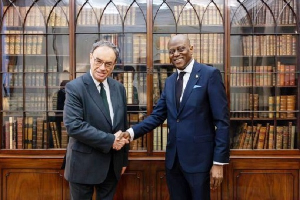 The Governor of CBN, Mr Olayemi Cardoso and the Governor of the Bank of England







Opinions