Nigeria’s port ship traffic, exports, and overall cargo in the third quarter of 2025 recorded sharp increases.
This is according to new data from the Nigerian Ports Authority (NPA).
The Authority said total cargo handled across the nation’s ports climbed to 33.52 million metric tons in Q3 2025, representing a 16.2 percent increase from the 28.84 million metric tons recorded in the same period of 2024.
The standout figure was a dramatic 1,085 percent surge in export-laden containers, highlighting a major boost in non-oil export activities.
Operational statistics showed that total container traffic rose by 18.9 percent to 546,931 TEUs, up from 460,038 TEUs a year earlier. Import-laden containers increased by 33.1 percent to 268,713 TEUs, while export containers jumped sharply to 69,039 TEUs from just 5,812 TEUs in Q3 2024. As exports strengthened, empty container movements fell by 21.5 percent, pointing to a more balanced trade flow.
Ship calls also recorded notable growth during the quarter. The number of vessels calling at Nigerian ports rose by 8.4 percent to 1,074 ships, compared with 991 vessels in Q3 2024. In addition, total Gross Registered Tonnage (GRT) increased by 18 percent to 42.64 million, indicating a rise in the number of larger vessels entering Nigerian ports.
Port-by-port analysis showed Tin Can Island Port accounting for the highest share of ship calls at 22.7 percent, closely followed by Apapa Port at 22.2 percent. Onne and Lekki Ports recorded 18.9 percent and 18.4 percent, respectively, while Calabar Port had the lowest share at 2.1 percent.
By vessel size, Lekki Port handled the largest ships, with an average GRT of 57,244, followed by Onne Port at 51,276 GRT. Apapa and Tin Can Island Ports recorded average GRTs of 35,556 and 34,400, respectively, while Delta Ports averaged 18,677 tonnes.
Cargo throughput figures further underscored Lekki Port’s growing dominance, as it accounted for 46.8 percent of total cargo handled in Q3 2025. Onne Port followed with 17 percent, Apapa Port with 15.1 percent, and Tin Can Island Port with 10 percent. Calabar Port recorded the lowest share.
A breakdown by cargo type showed liquid bulk leading with 53.8 percent of total throughput, followed by containerized cargo at 26.6 percent. Dry bulk and other general cargo accounted for 11.3 percent and 8.2 percent, respectively.
Commenting on the performance, NPA Managing Director Abubakar Dantsoho said the strong results reflect the impact of the Federal Government’s export-driven economic reforms, the policy direction of President Bola Ahmed Tinubu, and the strategic leadership of the Minister of Marine and Blue Economy, Adegboyega Oyetola.
He noted that ongoing port modernization projects, the rollout of export processing terminals, and digital initiatives such as the electronic truck call-up system have reduced congestion, improved efficiency, and boosted confidence in Nigeria’s maritime sector.
Industry analysts say the Q3 figures highlight the growing role of the ports in driving Nigeria’s non-oil export push and strengthening the country’s position in regional and global trade under the government’s broader economic diversification and blue economy agenda.
Business News of Wednesday, 17 December 2025
Source: www.dailypost.ng
Ship calls at Nigerian ports jump to 8.5% as cargo hits 33.5m MT in Q3
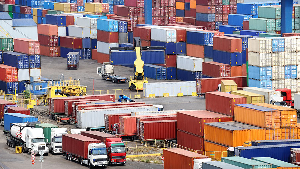 File photo to illustrate story


Opinions