The 2026 FIFA World Cup which kicked off June 11 is already on the home stretch. New stars have emerged while some established stars have justified their ratings. Yet, some dreams have been dashed. In all, the 2026 World Cup has brought about new narratives, created new heroes and uncovered several hidden facts about modern football. Above all fans across the globe have had so much to preserve as cherished moments of the quadrennial showpiece.
For football fans in Nigeria it has been sour grapes, considering that the national team, the Super Eagles are absent. Notwithstanding, enthusiastic football fans have not allowed the absence of the Super Eagles abort their plans for the tournament or stop them from watching the tournament on television. The gale of economic hardship has been relegated to the background. Despite the odd hours matches are being played in the Americas, diehard Nigerian fans stay awake to watch them. Mind you, the Super Eagles are not there. So, just imagine the outpouring of nationalistic fervour, bonding among Nigerians of different tribes, businesses thriving in many pubs, canteens, buckas and motor parks had Nigeria participated. That speaks to the power of football as a unifier.
Power of football in social cohesion
The question that readily comes to mind is, what would have been the case if the Super Eagles were in the tournament? Without the Super Eagles at the World Cup, Nigerians still keep late nights, to watch the matches. That, to a large extent, shows the power of football and its overwhelming influence among the country’s populace. There is an unwritten code in Nigeria that football is the king of sports. When the national team, the Super Eagles are involved in a match, every Nigerian rallies behind the team. The degree of patriotism exemplified by Nigerian football fans is second to none. That is one moment that underlines the strength of unity in diversity. Writing for an online platform The Cable under the topic: When politics divides Nigeria, football unites, Adebayo Abubakar states inter alia, “Give Nigerians football, and for 90 minutes (sometimes 120), they forget the galloping cost of living. Give them football, and pump prices, potholes, blackouts, and even secessionist rhetoric are put on hold. The irony is almost poetic: the same society that fractures violently along political, ethnic, and religious fault lines becomes, at kickoff, one indivisible republic. Tribe and tongue suddenly no longer differ. They stand in brotherhood—boots laced, hearts pounding, flag held high.” How true!
There is also a story that when the great Brazilian legend late Pele visited Nigeria with his Brazilian club Santos in the ’70s, something happened. During the Nigerian Civil War, hostilities temporarily halted so that soldiers of both sides could listen to the radio commentary of the legendary Pelé and his Santos FC team playing in Nigeria.
In the heated days of Boko Haram, a former coach of El Kanemi Warriors of Maiduguri, while explaining how the club was able to function and host teams, despite the Boko Haram scourge, once told this writer, “even Boko Haram watch football.” This, Adebayo put more succinctly, “Even Nigeria’s darkest actors are not immune. It would be naive to claim that kidnappers, bandits, and terrorists do not, at some point, glance at a screen to check scores or watch a big match. Football suspends reality; crime, grievance, and anger take a brief halftime break. That alone speak volumes about its social power.”
Football as a unifying force – Odegbami
Nigerian football legend Segun Odegbami famously describes football and sports as a potent, unifying force that is even “more powerful than governments” in creating hope, breaking down racial barriers, and healing divided nations. Throughout his advocacy and public lectures, including the 15th Distinguished Public Lecture at Federal University Lokoja, the former captain of the national team highlighted several core aspects of football’s power. He recalled how football helped in accentuating Nigeria’s reconciliation efforts after the bitter 30 month-civil war.
Odegbami said the establishment and early dominance of Enugu Rangers (The Flying Antelopes) after the civil war was one of the most powerful tools for national reconciliation in Nigeria. He highlighted how the club helped heal deep ethnic divides. He wrote, “With the end of the civil war in 1970, a “starved” East (Eastern Nigeria) came out roaring. A symbol of unity amongst the Igbos … It was as if the football club wanted to regain through football what the Igbo “lost” during the war”!
Has Nigeria maximised the gains of football?
The introduction of football in Nigeria predates the country’s independence. The Nigeria Football Federation(formerly Nigeria Football Association) was founded in 1945. Ever since, the country has churned out lots of stars that have won laurels for themselves and country. The Super Eagles have won the Africa Cup of Nations three times with countless runner up and bronze medals. With better coordination, accountability and the necessary infrastructure, the Nigeria national team would have been rubbing shoulders and competing with the best football playing nations in the world. Poor administration of the sport, particularly in the past ten years has made it impossible for the country’s football to move forward. Is it not baffling that for a country that has won the FIFA U17 World Cup five times, won the Olympic gold, silver and bronze medals in football failed to qualify for an expanded World Cup tournament that had ten African teams in attendance? This, for a country that parades the last two CAF Player of the Year Award winners.
Calls for change
The call for change in the leadership of the Nigeria Football Federation has been unequivocal. It has even become louder and intensified following the Super Eagles’ back-to-back absence from the World Cup. Nigeria produces some of the world’s best players. With some of the best players plying their trade in Europe, Nigeria’s absence at the World Cup is not only embarrassing, it also calls for deeper reflection among football stake holders and government in particular.
Former Nigeria captain, Mikel Obi described Nigeria’s failure to qualify for the ongoing World Cup as a ‘hammer blow’. Speaking on the Obi One Podcast, Mikel said, “I feel for the people of my country. I feel for my people in Nigeria because they are going to be devastated right now. I just feel the entire board of the NFF need to go. Twice in a row we failed to qualify. It means something is wrong. A drastic change has to be carried out.” Nigeriansports coverage
He continued his lamentation, “We are the biggest footballing nation in Africa and failing to qualify is an indication that something is wrong and that requires drastic action.”
Football as best tool for international diplomacy
Before the World Cup, countries like Cape Verde, Haiti, Curacao among others were little known by the rest of the world. But with their appearance at the Mundial, the national team of Cape Verde, for instance, in three weeks, accomplished for the country what ten Public Relations firms could not have achieved in ten years. If Nigeria had qualified, the Super Eagles would have done the best PR for the country; much more than paying millions of Dollars to mercenary firms to help secure ungoverned spaces with a view to laundering the country’s as a go-to destination.
Despite the universal condemnation of xenophobic attacks in South Africa, the country’s national team, the Bafana Bafana’s participation in the World Cup thawed the forty feeling in some quarters as global attention was shifted from the heinous activities of black South Africans’ xenophobic craze, to World Cup football. Despite their early exit in the Round of 32, the Bafana Bafana served the South African government and its people in good measure.
Economic losses
Football, like sports generally, is far beyond mere entertainment. In today’s world, football is business. The inability of Nigeria to qualify for the World Cup has caused huge losses for those whose businesses thrive under healthy sporting environments. Super Eagles’ absence from the World Cup affected sports practitioners like the players themselves, whose value would have been enhanced if they had a chance to play at the biggest stage. Sports journalists, marketers, advertisers, radio, television networks and print media generally, are still counting their losses. Even the content creators, big corporate organisations that would have identified with the national team as official sponsors for enhanced visibility and activation, drinking pubs, viewing centres, etc, are also counting their losses. All these would have benefited from Super Eagles trip to North America.
That aside, for qualifying for the Round of 16, Morocco would receive a whopping $31.5m(about N44 billion) from FIFA. It is strongly believed that with the quality of players Nigeria has, perhaps the Super Eagles could have done better than reaching the Round of 16, which would have amounted to more money, as the higher a team progresses, the more money they earn.
Providing employment
No other sector can provide mass employment or empowerment for the youth than football and sports in general. The age bracket for active sportsmen and women is between 18 and 25. This demographic segment is the most energetic and restive and if their energies are not directed positively, that could pose a very big social problem. Sports create employment and education through direct, indirect, and induced pathways. Direct opportunities include coaching, refereeing, sports journalism, physiotherapy, and event management. Indirect opportunities arise in sports apparel, equipment retail, embroidery, transport, catering, and tourism. Induced jobs are generated when increased incomes from sports spending stimulate other sectors. Journalism& News Industry
Conclusion
Aspiring sportsmen and women look up to stars who are ahead of them as role models. It is a shame if Nigeria can not sustain her own heroes by ensuring their participation in global tournaments that avail them the opportunities of once in a life time visibility which money alone can never buy. The best and most appropriate theatre for the emergenceand sustenance of new heroes is the football pitch and without competitions there cannot be heroes. It is incumbent on stakeholders to take the bull by the horns and effect the desired change.
Election into the board of the NFF comes up in September. This present board must be booted out if Nigeria’s football is to move forward.
Preparation for the 2030 World Cup, to be co-hosted by Spain, Portugal and Morocco should begin now with the dethronement of the present NFF board. Government must show more than a passing interest in the affairs of agencies running Nigeria football. And for President Tinubu, it will be to his advantage to pay more than a passing interest in the systemic maladministration of football in Nigeria. If Tinubu can not renew the hopes of Nigerians via the Super Eagles, then all hope is lost.
Soccer News of Friday, 10 July 2026
Source: www.vanguardngr.com
Attention President Tinubu: Poor football management: a grave national security concern
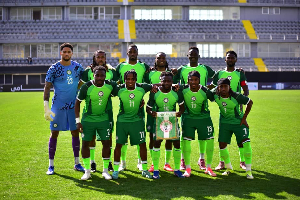 The Super Eagles of Nigeria