The Chairman of the Independent National Electoral Commission (INEC), Prof. Joash Amupitan, SAN, has urged Nigerians to trust his leadership to deliver free, fair and credible general elections in 2027, citing measurable improvements recorded in recent off-cycle elections and new technical safeguards designed to prevent a repeat of the 2023 controversies.
Prof. Amupitan spoke on Thursday 12th November, 2026, at Chatham House, London, during a high-level dialogue held in partnership with the Kimpact Development Initiative (KDI) under the theme, "Nigeria's 2027 Elections: Democratic Trajectory and Regional Stability Beyond the Ballot."
Addressing the trust deficit left by the 2023 presidential election, the INEC Chairman acknowledged that the controversies surrounding that exercise severely dented public confidence in the Commission.
"First and foremost, let me speak about what happened in 2023, which resulted in a significant trust deficit for INEC—damage so large that the Commission has not yet fully recovered from it," he said.
He, however, noted that since assuming office in October 2025, the Commission had treated every subsequent election as a practical laboratory for identifying operational weaknesses and strengthening accreditation, voting and result management.
Responding to a question on why Nigerians should trust his leadership ahead of 2027, Prof. Amupitan cited the conduct of the Anambra and Osun governorship elections, the Federal Capital Territory (FCT) Area Council elections, the Ekiti governorship election and 16 legislative by-elections.
"Why must Nigerians trust me? Nigerians must trust me because, number one, I have conducted off-cycle elections—and observers agree that the recent election in Osun State marked a clear improvement," he said. "Every election is a lesson. The 2023 general election was a major lesson for Nigeria, and the Anambra election was another."
He recalled that Anambra and Osun previously had histories of prolonged and inconclusive governorship contests, with the 2021 Anambra poll taking roughly five days to conclude. Under the current reforms, he said, results in both states were declared the day after voting.
Identifying insecurity, logistics and result management as the Commission's three top priorities for 2027, the INEC Chairman said a post-2023 audit traced the most acute result management failures to collation centres rather than polling units.
He announced that INEC has built strict validation safeguards into its system to ensure that inaccurate results, or figures reflecting over-voting, cannot be uploaded to the INEC Result Viewing Portal (IReV).
"We found that the core problem of election result management and declaration in Nigeria is not even at the polling unit—it is at the collation centres," he explained. "In 2023, there were instances of inaccurate results or results with over-voting being uploaded onto IReV. We have now devised a technical safeguard: if a result is not accurate at the polling unit, it will not go to IReV at all."
He added: "The moment a result appears on IReV, citizens can trust what they see. By eliminating inconsistencies at the source, collation will become a transparent formality."
Prof. Amupitan disclosed that although INEC considered introducing an entirely new electoral technology for 2027, it opted to upgrade and harden its existing infrastructure because of the tight operational timeline before the polls.
On the malfunction of the Bimodal Voter Accreditation System (BVAS) linked to extreme heat and storage conditions in 2023, he said INEC is constructing climate-controlled storage facilities in all states.
He added that the Commission has procured extra devices and reduced the maximum number of voters assigned to each BVAS machine from 1,250 to 850.
ASA
General News of Friday, 13 November 2026
Source: www.mynigeria.com
Why Nigerians sould trust INEC – Amupitan
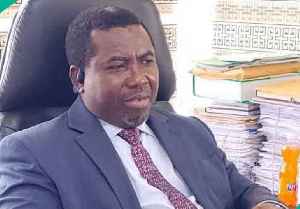 INEC Chairman Joash Amupitan