Presidential candidate Peter Obi has defended the Catholic Church, saying it has never functioned as an opposition party in Nigeria.
In a statement, Obi pointed out that across military regimes and successive democratic administrations, the Catholic Bishops’ Conference of Nigeria (CBCN) has maintained a principled voice on national issues and the nation’s conscience, commending governments when they deserved commendation and speaking the truth whenever national conscience demanded it. He said its interventions are driven by a moral obligation, rooted in Christian social teaching, to defend truth, justice, and the common good.
He said the same applies to Nigeria’s major religious organisations. Bodies such as Jama’atu Nasril Islam (JNI), the Supreme Council for Shari’ah in Nigeria (SCSN), the Christian Association of Nigeria (CAN), and the Nigerian Supreme Council for Islamic Affairs (NSCIA) have repeatedly raised concerns over economic hardship, inflation, and insecurity.
Obi said this in a statement titled, 'When a Government Declares War on the Truth,' after the Presidency criticised CBCN, led by Archbishop Cardinal John Onaiyekan, accusing it of partisanship for speaking up on poor economy and security against facts.
Justifying the religious leaders, Obi stated that living among the people, they often encounter the suffering of citizens firsthand. He said they speak because they witness families struggling with rising food prices, unemployment, and the fear created by kidnappings and insecurity.
He said, "As leaders, we should be gracious enough to listen to people and organisations that speak the truth to us and genuinely criticise us when things are not going in the right direction. As Governor, I had the opportunity of working with a very strong Council of Traditional Rulers, led by the Obi of Onitsha, and religious bodies that consistently criticised me and offered suggestions. This contributed greatly to our success in Anambra State, especially in critical areas like education and health.
"Against this background, the attacks on the CBCN, and especially on His Eminence, John Cardinal Onaiyekan, are deeply troubling. Even in 1998, when Pope John Paul II visited Nigeria and told General Abacha some hard truths, including about the incarceration of Chief Moshood Abiola, nobody vilified him.
"During the inauguration of Pope Leo XIV in Rome, to demonstrate his purported commitment to and respect for the Catholic Church, President Bola Tinubu arrived in Rome days before the event, ahead of most other visiting dignitaries, including Catholics such as the U.S. Vice President, JD Vance. He participated in the liturgy, queued with other world leaders to greet the Holy Father, and displayed deep respect for the moral authority of the Church. Back in Nigeria, however, that posture has now changed completely.
"What is playing out today also reveals how political leaders sometimes exploit religion and ethnicity to divide the people. Even when it was obvious that the CBCN was speaking on issues affecting Nigerians across religious and ethnic boundaries, aides to the President immediately reduced it to a “religious affair.” The question is: are insecurity, poverty, inflation, unemployment, and hardship problems exclusive to a particular faith? Do these challenges recognise religious or tribal boundaries?
"The bishops merely expressed what millions of Nigerians experience daily: insecurity has worsened, poverty is deepening, inflation is crippling families, businesses are struggling, and hope is fading. These are realities echoed by religious leaders across the country, to whom successive governments gave thanks and promised to look into their observations.
"Rather than address these concerns or explain the measures in place to ameliorate them, President Bola Ahmed Tinubu’s aides and supporters responded with vicious attacks, particularly against Cardinal John Onaiyekan, with little regard for his age, stature, and accomplishments.
"Here is a man who had the best Higher School Certificate result in the old Northern Region in 1962 and who rose through the ranks of the Catholic Church to become a Cardinal, a position that places him among those eligible to be considered for the papacy. Yet he is no ordinary cleric. He is one of Africa’s most respected churchmen, known for decades of service to peace, dialogue, scholarship, and national unity. Resorting to personal attacks against him weakens public discourse and reveals an unhealthy intolerance of criticism in today’s Nigerian political space.
"Throughout history, religious leaders have challenged political authorities. Biblical prophets confronted kings, and modern faith communities continue to hold governments accountable. Nigeria has a similar tradition. The Catholic Church criticised military governments and successive civilian administrations, including those of Obasanjo, Yar’Adua, Jonathan, and Buhari. Muslim organisations have done likewise. Governments respectfully disagreed at times, but they generally recognised the right and responsibility of religious bodies to speak. Why, then, does the truth provoke such anger today?
"The problem often begins when leaders surround themselves with voices that tell them only what they want to hear. Napoleon Bonaparte was reputed to have preferred hearing bad news because problems were where leadership was required. During my tenure as Governor of Anambra State, I maintained a similar philosophy. I expected cabinet members to bring me problems, not compliments, because only honest feedback could lead to solutions.
"Good governance depends on truth. When governments punish truth-tellers and reward sycophants with appointments, honest advisers withdraw, sycophancy thrives, and leaders become disconnected from reality. This is our situation today.
"The CBCN did not insult the President and can never do so, given the calibre of the people who make up the Conference, some of the finest among Nigerians. It gave voice to the suffering of Nigerians. The proper response was to thoughtfully address the issues raised, not attack those who raised them. When respected figures like Cardinal Onaiyekan are vilified for speaking the truth, the message sent to citizens is that silence is safer than honesty. No democracy can flourish under such a culture.
"Religious leaders should continue to speak because silence in the face of suffering would betray their moral responsibility. The greatest service those around President Tinubu can render him is an honest appraisal of the situation. A leader who hears only praise will never fully understand the pain of his people or find the clarity needed to correct what is wrong."
ASA
General News of Wednesday, 5 August 2026
Source: www.mynigeria.com
Obi faults Presidency's criticism of Cathoic bishops, says 'When govt declares war on truth'
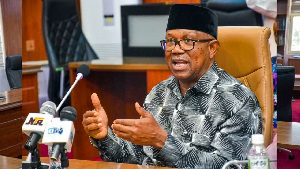 NDC presidential candidate Peter Obi




Opinions