The article below is a Citizens Newspaper story from 1991, which exposes the lie that the first Home Video movie produced in Nigeria was Living In Bondage and that Igbo people started Nollywood.
The article reveals that the first Home Videos ever sold in Nigeria were Yoruba movies, and that Aje N'Iyami is the first movie ever contracted to be officially sold as Home Video.
An Igbo man was, however, behind the sale of Aje N'Iyami.
Read:
The Nigerian film culture sets for a change with the introduction of indigenous video films.
They were all there. Toasts of the Yoruba big screen acting: Charles Olumo (Agbako); Bashiru Ishola (Oloye Ajere); Kareem Adepoju (Baba Wande); Iyabo Ogunsola (Efunsetan); Francis Daramola (Egbeji); Nike Gboye (Iya Beji); Rasaq Ajao (Ar-aoso); Ishola Ogunsola (Dr I show Pepper)...
But what could they be doing at NEK Video Links, an essentially video centre?
It was a simple advertisement placed on the radio that brought them. Mission: To take part in a series of movies that would be shot in professional U-Matic, transferred to VHS and sold directly to home users.
Mr Segun Taiwo, chairman of Nigerian Film Exhibitors' Association, and proprietor, Ayota Arts Centre, who abandoned his doctoral programme at the University of Ibadan to pursue film business, explains: "The idea is certainly not new, but the approach is. For a long time, some artistes have been recording on video and selling to friends. Sometimes, these are taken to cinema houses and screened on video-matics. This is the first time, however, that a company is coming out not only to produce films on video but also to market them. It is a welcome development," he continued. "This will help artistes to project their works."
Not so, says Ade Afolayan (Ade Love), maker of the block-busting Taxi Driver, "those doing it have no other way to maintain themselves. They just want to keep body and soul together. They are selling their talents cheaply. Honestly, I don't know what takes people do it."
"What opponents of video films don't know", explains Segun Taiwo, "is that video is just a medium of transmission. With a telecine, conventional films on 16mm and 35mm can easily be transferred to video. I think the government should encourage artistes to make films on video as far as such films are censored and only for home use. The truth is that a lot of people want to watch films in the comfort of their homes." And that was what started it for Kenneth Nnebue, group chairman of NEK Video Links, who speaks very "little Yor-uba." Watching late Hubert Ogunde's Aiye and Aropin Ntenia, he was moved by the rich Yoruba cultural background of the films. He saw a wide audience, mostly elites, lost to the magic on the screen simply because they could not get to the cinema houses. Something, he felt, had to be done. And with a digital studio, which has state-of-the-art editing facilities, he set out on the project...
The artistes contacted were only too glad to be part of the experiment. In fact, he got the best hands, including directors and writers. "I pay them good money. Remember, it is talent I'm paying for," he explains in his tastefully furnished office. The first film released in March this year was Aje Ni Iyami. It got enthusiastic response. By November, eight others had been produced, and for the Christmas and New Year season, he is releasing five more. "I love the business," the former electronic parts dealer says of how he feels being a video film producer. "My happiness comes from satisfying my audience." And this is widening by the day. "I get calls from Kaduna, Port Harcourt, Jos and Ibadan all asking for films," he maintains, smiling.
On his plans for the future, he says: "I will soon come out with the I have been English version, making contacts with the big actors in English for the project. Soon, too,
Nnebue: "My happiness comes from satisfying my audience." I'd be producing the Igbo, Hausa and Edo versions..." Quite an ad-venture!
"What he is doing," says Afolabi Adesanya, of A-Productions, maker of highly rated Vigilante and the recent Ose Sango, "is a revolution of sorts in the audio-visual market. People either have to go to the cinema house or stay at home and watch videos, depending on whether they want a communal, family or personal feeling. Whichever is the case, it is cheaper entertainment for the audience."
General News of Wednesday, 1 April 2026
Source: www.mynigeria.com
THROWBACK: Old newspaper article shows Yoruba movie was first home video, not Living In Bondage
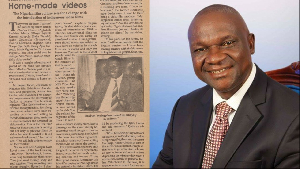 NEK Video Links boss, Kenneth Nnebue