A Nigerian police unit set up to tackle kidnapping and armed robbery in Imo state has instead been unlawfully killing suspects, torturing and ill-treating detainees to coerce them into confessing to bogus crimes, and arresting people for the sole purpose of extracting lucrative bribes for their release, Amnesty International said today.
Based in Owerri, the capital of Imo state, the police unit known as “Tiger Base” is increasingly being used to arrest and detain people to settle scores, including land disputes and family conflicts. Amnesty International’s investigation Tiger Base of Atrocities: Human Rights Violations by Nigeria Police Anti-Kidnapping Unit in Owerri published today found that detainees are kept in filthy, windowless cells and subjected to regular beatings. Many are locked up for weeks or months, without charge. Others have been shot or forcibly disappeared.
“Tiger Base has become synonymous with police operating outside of the law and abusing their power to enrich themselves through extortion. The atrocities committed by the Tiger Base police unit is yet another sign of the Nigerian authorities’ failure to end widespread torture, extrajudicial execution, extortion and other crimes at the hands of law enforcement. Many are traumatized forever. Despite the horrific violations they have suffered, there has been no accountability to date,” said Isa Sanusi, Director of Amnesty International Nigeria.
Torture, ill-treatment and prolonged unlawful detention
Many detainees locked up at Tiger Base’s detention centre are not asked for their statements regarding the allegations they face, and neither are they brought before a court. This enables the police to unlawfully detain people for indefinite periods of time without arraignment, thereby depriving them of essential procedural safeguards.
One survivor of prolonged unlawful detention told Amnesty International:
“They arrested me insisting I bought stolen items. I told them I didn’t know anything about it. They locked me up and seized my phone. After about three weeks, a police officer came to take my statement. Still, they kept me locked up…. They later told us that the complainant claimed her loss was worth ₦14 million (US$9,500) but that she agreed to collect ₦4.5 million (US$3,100) instead. They said if I wanted to be released, my family would pay.”
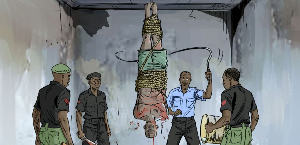
Former detainees said they were forced to write incriminating statements under torture, which included severe beatings with iron rods and cables. Knives, machetes, batons, water and whips were also used to torture suspects. Some detainees were tied up with ropes so that their bodies were hanging. Then they were cut and their wounds left to bleed.
The resulting coerced “confessions” were used by police to demand a bribe that would have to be paid before a detainee could be released on bail. Former detainees said Tiger Base officers illegally arrest and detain dozens of people every day with the sole aim of extorting money from their relatives in exchange for suspects being released.
There is a thriving illegal point of sale (POS) business within the premises of the Tiger Base detention centre. In Nigeria, handheld POS machines act like an ATM allowing people to withdraw cash instantly from their bank accounts.
Our investigation shows that, at Tiger Base, officials from time to time take out inmates from the cells and shoot them. A survivor told our organization: “The other guy took him out, we heard gunshots, we thought they had killed him but after some hours in the night he came into the cell. We looked at his leg, and they shot him. He is carrying bullet wounds inside the cell with us; nobody cares.”
Inhuman and degrading conditions in detention
Each of Tiger Base’s four main detention cells measures about 12 feet by 12 feet with more than 70 people squeezed inside. As a result, detainees are forced to take turns either to sit or squat.
Testimonies collected by Amnesty International indicated that few people sent to Cell 1 came out alive. According to a former detainee: “If you survive Cell 1, it is only by God’s grace. Many people disappeared after being moved there; nobody ever saw them again.”
There are no windows in the cells and only one toilet per cell, which overflows with waste as people are forced to urinate, defecate and sleep in the same small place. The stench is unbearable. Former detainees reported seeing their cellmates passing out from overcrowding, intense heat and exhaustion.
“People [in the cells] will be crying: ‘someone is dying here!’ They [officials] will still lock the cell gate…Then, even if they bring you out, they will still beat you up to see whether you are pretending or not. Then, they will take you out and keep you in the corridor for air. If you regain consciousness, they will throw you back into the cell…” one former detainee told Amnesty International.
Deaths in detention
Several people were reported to have died in the Tiger Base detention centre. In 2022, three youth leaders handed over a suspect to the Tiger Base unit. About three months later, the young man, Okechukwu Ogbedagu, died in detention.
Amnesty International has reviewed an autopsy report which showed that Okechukwu Ogbedagu died of asphyxiation. To cover up their atrocity, Tiger Base officers charged the three youth leaders who handed Okechukwu Ogbedagu to them with murder. They were released after about six months.
In another case documented by Amnesty International, on or around 5 May 2025, Japhet Njoku, a security guard who was accused of stealing, died in Tiger Base detention. Police officials told his family members following days of repeated demands, that he was beaten to death in his cell. Since then, Tiger Base officials have frustrated every attempt to conduct a coroner court-ordered autopsy to ascertain the cause of Japhet Njoku’s death—they have failed to turn up for the autopsy on four different occasions, despite the availability of the court-appointed pathologists.
Police impunity
“The atrocities committed by the Tiger Base police unit is yet another sign of the Nigerian authorities’ failure to end widespread torture, extrajudicial execution, extortion and other crimes at the hands of law enforcement. It appears the police have not learnt any lessons from the #EndSARS protests. Instead of being held accountable, corrupt police officers have been emboldened to commit human rights violations by the impunity they enjoy,” said Isa Sanusi.
The atrocities committed by the Tiger Base police unit is yet another sign of the Nigerian authorities’ failure to end widespread torture, at the hands of law enforcement.
Isa Sanusi, Country Director, Amnesty International Nigeria
The Nigerian authorities must promptly establish an independent, impartial and effective investigation of the atrocities committed by Tiger Base unit police officers in Owerri, Imo state. The investigation must also examine the conduct of the Commander and other officers at the Tiger Base detention centre, their involvement in human rights violations, corrupt practices and other misconducts.
Police officers at Tiger Base are not above the law and must comply with the provisions of section 62 of the Police Act, which requires anyone arrested for a non-capital offence to be released within 24 hours with or without surety.
“Under Nigeria’s constitution and international and regional human rights treaties authorities have an obligation to ensure that human rights violations uncovered at Tiger Base are investigated and suspected perpetrators brought to justice, while victims receive adequate reparation,” Isa Sanusi.
BACKGROUND
The Anti-Kidnapping Squad, popularly known as Tiger Base, operates under the Imo state Police Command located in Owerri south-east Nigeria. Originally established to investigate and combat kidnapping-related crimes, the unit has significantly deviated from its core mandate. In recent years, Tiger Base has become notorious for systemic abuse, including, unlawful arrests, prolonged arbitrary detention, torture, extortion, enforced disappearances – including the removal of children from their mothers without records – and corruption.
General News of Wednesday, 25 February 2026
Source: www.amnesty.org
Tiger Base police unit involved in rampant violations including extrajudicial executions, torture and extortion
 Illustrative photo