


The Federal Government and 268 Nigerians repatriated from South Africa have rejected claims by Pretoria that all those returned to the country, yesterday, were undocumented, blaming delays on South Africa’s Home Affairs system for pushing many illegal status.
The evacuees accused the South African government of delibrately delaying renewing their work permits and other documents, to have a reason to clampdown on Nigerians, while their security agencies extort them.
The Federal Government , has, meanwhile, pledged to activate the Nigeria-South Africa Binational Commission and the newly established Early Warning mechanism in order to respond faster to future threats against Nigerians in South Africa.
Also, some of the evacuees put the blame of their irregular status on the Nigerian Mission in Pretoria, saying that bureaucratic bottlenecks within the Commission further frustrated efforts to regularise their stay in South Africa.
Recall that the South African authorities had shortly before the departure of the evacuees from OR Tambo International Airport on Wednesday, claimed that all the 268 Nigerians cleared for repatriation were undocumented and were residing illegally in the country and slammed a five-year travel ban on them.
“The 268 departing first were all undocumented. None of the 268 Nigerian nationals who arrived at OR Tambo International Airport for repatriation on Wednesday are in South Africa legally. Not a single person of the 268 is legal,” South Africa’s Head of Immigration Enforcement, Stephen van Neel, said.
But pushing back on the claims, yesterday, at the reception of the first batch of the evacuees, in Lagos, Nigeria’s acting High Commissioner to Pretoria, Ambassador Temitope Ajayi, who led the evacuees, back to Nigeria, said the undocumented label was false and misleading.
“Many of these people you are seeing here, Minister, are not undocumented persons. Many of them became undocumented because of systemic failures of South African Home Service. Some have submitted requests for the extension of their resident permits for years. It takes two years, three years, five years, some are still lying down there. So, in the process, they were caught up in this.”
He described the S’Africa Home Affairs as a transactional section where backlogs and delays had left legitimate applicants stranded.
“So, because of this delay, and the general problem in the system itself, it made many people become undocumented. So, it is false and totally misleading for a body of officials to mention, to put it in the news before we landed, that 268 Nigerians that came back were undocumented in South Africa,” he added.
Tinubu ordered evacuation despite pressure
Speaking further, Ajayi said that President Bola Tinubu initiated the evacuation in April after xenophobic violence erupted, setting up a hotline with the Ministry of Foreign Affairs and the mission in Pretoria for daily updates.
“Mr President was so agitated and he wanted his people to return to Nigeria. Every day he was on the phone asking the Minister and us what was happening on the ground and what he could immediately do to intervene.”
According to him, Tinubu faced pressure from world leaders and the South African president, Cyril Ramaphosa, to halt the repatriation over the “bad optics” it had given to South Africa.
“But Mr. President was always very consistent, because he knew where he was going. And he said, any attack on my people in South Africa is an attack on me, and you must bring my people back,” Ajayi said.
Five flights planned for June
Ajayi further explained that the government arranged five Air Peace flights to bring Nigerians home. Wednesday’s arrival was the first batch of 268 evacuees, including women, men and children. The next flights, according to him, have been scheduled for June 15, 18, 22 and 24, with the exercise expected to conclude within the month.
Ajayi said the process involved a three-stage screening coordinated with South Africa’s Foreign Ministry, Home Affairs, Immigration Service, Border Management Office and Intelligence Service involving biometric identification, immigration clearance, and issuance of emergency travel certificates for those without documents.
He lamented that despite agreement with the South African authorities not to speak to the press until the operation was completed, S’African officials broke the protocol.
“I don’t want them to politicise this kind of operation because it’s beyond politics. It’s not something we should take the vulnerability of people to turn into spectacle,” he said.
We will activate early warning, binational Commission to protect Nigerians in S’Africa —Foreign Ministry
In his remarks, the Minister of State for Foreign Affairs, Amb. Sola Enikanolaiye, assured that the Federal Government would activate the Nigeria-South Africa Binational Commission and the newly established Early Warning Mechanism to respond faster to future threats against Nigerians in South Africa.
He said President Tinubu sent him to assure the evacuees, that the government was undertaking reforms to make Nigeria livable so that citizens would only travel abroad for holidays.
“It is with mixed feelings that I address you this afternoon, happy to welcome you. I’m a little bit not so happy because I know the kind of trauma that my people went through.
“Mr. President has asked me to welcome you back home. Home is home and to assure you that he is doing everything possible by way of various reforms to make the home good for all of us,” he said.
On Nigeria’s diplomatic response, the minister said engagement and dialogue remained the government’s approach, even under difficult circumstances.
“Our job is to manage relations. Even under the most difficult circumstances. We believe in diplomacy. We believe in engagement. We believe in dialogue,” he said.
To make that engagement more effective, he said two mechanisms would be activated and listed the Binational Commission, which covers economic, political, defence and humanitarian relations between both countries, and the Early Warning Mechanism set up to address specific security concerns.
“I’m aware of some of the issues that have been raised with the latter, but I want to assure you, we are going to activate these mechanisms, so that we can respond more quickly, in a more proactive manner to situations that may occur in the future,” he told the returnees.
He said the government would continue to engage Pretoria to ensure Nigerians receive better treatment going forward.
FG pledges dignified reintegration for evacuees
The Minister of Humanitarian Affairs and Poverty Reduction, Dr. Bernard Doro, said the Federal Government was handling the return of 268 Nigerians from South Afa in a coordinated and dignified manner, adding that the healing and reintegration process had already begun.
He explained that the immediate priorities were safe reception, attending to basic needs, and profiling returnees to understand their skills, vulnerabilities, family situation and support needs.
The profiling, he explained, would guide referrals to government agencies, international organisations and partners for psychological support, skills development, livelihood linkages, medical referrals, family reunification, and documentation assistance.
The minister thanked the Ministry of Foreign Affairs for facilitating the return and said President Tinubu had committed significant resources to the effort.
MTN, Uzodimma pledge cash, phones as FG rallies support for evacuees
Chairman/CEO of Nigerians in Diaspora Commission, NiDCOM, Abike Dabiri-Erewa, said the Federal Government had secured immediate relief packages from private firms and state governments for the returnees as part of efforts to help them reintegrate back home.
The NiDCOM boss said the Commission was working with sub-national governments and private sector operators across various sectors to secure relief and support reintegration.
She stated that Governor Hope Uzodimma of Imo State, MTN Nigeria Communication Plc and other private companies had pledged relief packages, ranging from cash transfers to mobile phones.
Dabiri-Erewa said Governor Uzodimma had specifically pledged N1 million for each returnee.
“MTN is here, and we’ve been working with them. They are going to transfer N100,000 each to your accounts. And that’s not all, they are going to give you N50,000 airtime and they will also be giving you starter packs, so you can have phones to use when you get home,” she told the returnees.
She noted that beverage company, Crockstone was on ground to hand out envelopes to the returnees “for you to be able to buy some drinks or whatever.”
Nigeria High Commission also sabotaged efforts to regularise our stay in S’Africa —Evacuees
Meanwhile, most of the returnees who spoke with Vanguard at the airport also rejected the claims that they were illegal migrants, saying that Nigeria High Commission in South Africa complicated their problem by making it difficult for them to renew their papers.
They recounted harrowing experiences of xenophobia, including extortion, discrimination and intimidation, urging fellow Nigerians still residing in the country to consider returning home.
One of the evacuees, who simply identified herself as Peace, said the Nigeria High Commission in Pretoria also made it difficult for citizens to renew their documents, worsening the illegal status many found themselves in.
Peace, who said she lived in South Africa for 13 years and worked legally until her permit expired, claimed South African authorities deliberately refused to renew permits to force foreigners out.
She added that the Nigeria High Commission compounded the problem.
Peace alleged that in 2023, during the election campaign, commission officials collected R2,700 each from over 9,000 Nigerians in Johannesburg for passport booklets, demanding cash instead of bank transfers. According to her, only 500 passports were delivered from Nigeria, and officials later advised applicants to “go and apply for another passport” if they had money.
“I blame the Nigerian government. They are frustrating us, both in foreign land and also here,” she said.
Peace also questioned the relief package process promised them, saying she had no Nigerian bank account or internet access after 13 years abroad, and did not know what account to provide for transfers.
“My heart is really bleeding. I owe my children an apology for making them Nigerians,” she said, adding that her children were treated better in South Africa than in Nigeria.
Another evacuee named Emmanuel Nwachukwu, alleged that hostility towards foreigners, particularly Nigerians, had intensified in parts of South Africa, claiming that some groups had threatened violence against African migrants who refused to leave the country.
“They said they will start shooting at the remaining people who do not want to go home,” he said.
According to him, many Nigerians living in South Africa face frequent harassment from law enforcement officials and other security agencies and even extorted.
“Once they know you are a Nigerian, police and other security agencies will come to extort you. Day in and day out they are doing that,” he alleged.
Responding to questions about the legal status of many Nigerians in South Africa, Nwachukwu acknowledged that a significant number of migrants lack valid documentation but argued that bureaucratic obstacles make it difficult for foreigners to regularise their status.
“They say we are staying illegally, but they are not giving people documents. How can you not document people and then start tagging them as illegal immigrants?” he asked.
He further alleged that undocumented migrants are routinely targeted for extortion and intimidation.
“They know people do not have papers, so they go after them, frustrate them and take money from them every day. As long as you are a Nigerian, you are a target,” he claimed.
Nwachukwu also accused immigration authorities of creating obstacles for foreigners seeking to leave the country.
“When you get to the international airport and want to go home, they will tell you your documents are not complete and find reasons to send you back to prison. They are recycling people as slaves in that country,” he alleged.
I decided to leave after my clothing business was shut down
Another evacuee, who refused to give his name, said he left South Africa after his clothing business was shut down by locals who accused foreigners of “taking their jobs.” He stressed that he and other Nigerians were not working in government or formal offices, yet still faced hostility and jealousy from locals.
He denied claims that returnees were illegal immigrants, stating he had been in South Africa since 1998 and had valid documents. “There is nothing like that. That’s what they use to chase us away,” he said. He also cited an incident at Victoria Airport where 12 people were reportedly shot the previous morning, and said such attacks were why he chose to leave.
The evacuee noted that his wife and two children remain in South Africa, but he decided to return first to secure his life and start over in Nigeria. “I am not planning to go back there. This is the second half, I have already played my first life there. I am coming back home to play the second half,” he said.
Attacks going to get worst
Sandra Omotala-Adeniyi, a 26-year-old evacuee who spent 11 years in South Africa, said she came back home to continue her education after finishing high school in 2024.
She explained that advancing her studies in South Africa was difficult because foreign students were rarely granted study permits and bursaries require a South African ID. “I have been wanting to come home for a very long time. This is a great opportunity for me to come home,” she said.
Omotoa-Adeniyi said she did not personally face much discrimination in Kempton Park, where she lived, but witnessed it as a high school prefect. Students often reported being called “foreigners,” and she said she saw attacks on foreigners on social media.
Citing fears of renewed violence ahead of June 15, she urged other Nigerians in South Africa to return. “Guys, just come home, it’s going to get worse. They are going to keep on looting, attacking and molesting our people. They do it almost every four years,” she warned.
Another evacuee, Mr. Chukwuemeka Chris Okeke, expressed gratitude to the Nigerian government and individuals who facilitated their return, saying the situation in South Africa had become unbearable for many African migrants.
“There is no place like home. We are passing through a lot in South Africa. I really appreciate our President and others who supported in bringing us back home. I thank our government so much. May God bless Nigerians,” he said.
Despite the challenges he experienced abroad, Okeke expressed optimism about Nigeria’s future and called on citizens to work together to improve the country.
“I am so happy to be here. I appeal to Nigerians, let’s join hands together to make Nigeria great,” he added.
Offering advice to Nigerians still residing abroad, Okeke urged them not to allow pride or fear of embarrassment to prevent them from returning home.
“There are many Nigerians who don’t want to come back because of shame. They have been there for years and don’t have money. I told my friends to forget the shame and let’s go home. No place like home,” he said.
He also claimed that many foreigners struggle to renew immigration documents, leaving them vulnerable to arrest and harassment.
“I have papers, but they have expired. I went for renewal, but they could not renew them. That’s why when you see police or immigration officers, you are running. Our lives are not safe there,” he said.
Air Peace laments xenophobic attacks, backs evacuation of Nigerians
Meanwhile, West Africa’s largest airline, Air Peace, has expressed sadness over the circumstances that necessitated the evacuation of Nigerian citizens in South Africa, describing the situation as unfortunate and deeply concerning.
Air Peace’s Chief Commercial Officer, Mr. Nowel Ngala, in a statement by the Spokesperson for the airline, Efe Osifo-Whiskey, reaffirmed the airline’s commitment to humanitarian service.
He said airline’s flying the returnees back to Nigeria aligned with the patriotic vision of Air Peace Chairman and Chief Executive Officer, Allen Onyema, whose philosophy has consistently placed national interest, compassion and service above commercial considerations.
Ngala said that Air Peace remained ready to support Federal Government in safeguarding Nigerians wherever they might be and disclosed that discussions were ongoing regarding additional evacuation flights should the need arise.
General News of Friday, 12 June 2026
Source: www.punchng.com
Xenophobia: FG, evacuees slam S’Africa over documentation claims
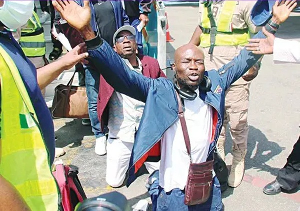 The photo used to illustrate the story







Opinions
