The Federal Government has defended the decision by the Nigerian National Petroleum Company Limited (NNPCL) to forego a portion of its corporate profit margins, assuring citizens that President Bola Tinubu will not leave households to bear the full brunt of rising global fuel prices alone.
Speaking during a media briefing in Abuja on Monday, October 12, 2026, the Minister of Information and National Orientation, Mohammed Idris, clarified that NNPCL's intervention serves as a temporary buffer against unexpected international market shocks and does not represent a reversal of the administration's petrol subsidy removal policy.
Idris explained that recent geopolitical tensions—including conflicts in the Middle East—have driven up global crude oil prices, forcing governments worldwide to adjust.
"President Bola Tinubu is a listening president. He cannot just sit and watch his countrymen face pressure they did not see coming and then do nothing about it. When subsidy was removed, of course, the Iran-U.S. war didn’t exist. So at every time, government is a continuously evolving system," Idris stated.
Highlighting NNPCL’s mandate as a state-owned limited liability company tasked with safeguarding national energy security, Idris noted that the firm opted to absorb part of the price increase rather than pass the entire cost onto consumers.
"What the NNPC has done is they have looked at it and said, 'okay, we’re making this much profit, why can’t we forego some of the profit that we are making so that Nigerians will have some form of cushion?'" the Minister noted. "It is within its right to look at what their own margins are and in the interest of the energy security and stability that we need as a nation, create that kind of buffer."
Reiterating the administration's broader economic outlook, Idris highlighted key macroeconomic improvements, noting that Nigeria's economy is projected to grow by over 4% in 2026. He added that inflation dropped to approximately 15% from 27% in January 2025, while external reserves crossed $54 billion in September—marking the highest level in nearly two decades.
The Minister assured that the government's primary focus remains translating these macroeconomic gains into tangible relief at the marketplace, petrol station, and household level.
As a deregulated market, Nigerian pump prices remain tied to international refined petroleum benchmarks. Global supply disruptions in 2026 have exerted upward pressure on landing costs across imported petroleum products.
NNPCL's Corporate Framework: Following the passage of the Petroleum Industry Act (PIA), NNPCL transitioned into a commercial entity operating under the Companies and Allied Matters Act (CAMA), giving it commercial autonomy to adjust trading margins to support market stability.
ID
Business News of Monday, 12 October 2026
Source: www.mynigeria.com
'Tinubu won’t abandon Nigerians' - FG defends NNPCL profit sacrifice amid fuel price surge
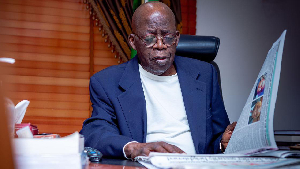 President Bola Ahmed Tinubu