Kenyan President William Ruto says his government is fast-tracking administrative processes for the proposed Dangote refinery in Lamu, Kenya. This is as Africa’s richest man, Aliko Dangote, said the planned facility would be bigger than the existing Nigerian plant.
Ruto spoke on Friday during a tour of the Dangote Petroleum Refinery in Lekki, Lagos, ahead of the September 30 groundbreaking ceremony for the proposed 700,000-barrel-per-day refinery in Lamu, Kenya.
The Kenyan President said his government had already secured the land for the project and is working on other requirements to eliminate bureaucratic bottlenecks and ensure that construction and subsequent operations are not delayed.
He described the proposed refinery as a regional project that would expand industrial activities in East Africa, create employment opportunities and improve the technical skills of the region’s workforce.
“I just want to tell the Dangote family here that the government of Kenya is one hundred per cent behind your project, our project. We have already secured the land that is necessary for this.
“We are working on all the other enablers to make sure that we don’t spend time on doing administrative bureaucratic stuff. We spend time on doing what we must do so that at the earliest opportunity we can refine products out of Lamu in Kenya,” Ruto said during the visit.
The assurance came as Dangote outlined plans for a larger industrial complex in Kenya, including a power plant with 1,000-megawatt generation capacity, twice the one at his Lagos refinery.
Dangote explained that the visit was arranged to enable Ruto to see the Lagos refinery physically and appreciate the scale of the investment before embarking on a similar project in Kenya.
He said the Kenyan president’s presence at the facility was significant because it offered him an opportunity to understand the infrastructure, equipment and technical requirements involved in developing a refinery of such magnitude.
Dangote described Ruto’s visit as an important show of support for the proposed Lamu investment, adding that the Kenyan project would have a wider economic impact beyond petroleum refining.
He said the refinery would serve as a catalyst for other investments, attracting businesses and industries that could take advantage of the infrastructure and petroleum products to be produced at the facility.
Dangote also disclosed that the proposed Kenyan project would include a million-tonne polypropylene plant, similar to the petrochemical facility at the Lagos complex, to support the development of downstream industries.
Polypropylene is used in the production of several industrial and consumer products, including plastic pipes, electrical cable coverings and furniture.
According to Dangote, the Lamu project would also have additional processing facilities that are not available at the Lagos refinery, reflecting differences in the crude oil and product requirements of the two facilities.
“We will have some of the equipment that we have here, maybe like the RFCC, will be much heavier. And then you also have the coker, which we don’t have here, because of the type of crude that we have. And we also have VDU, which we also don’t have here. So, this will give you a sense of an idea of what we are going to have in Kenya. But Kenya will be a little bit bigger than what you are going to see,” Dangote told Ruto.
He added that the company intended to use the experience gained from constructing and operating the Nigerian refinery to develop the Kenyan facility, while adapting it to the country’s industrial and energy needs.
The proposed Lamu refinery is expected to have a processing capacity of 700,000 barrels per day, compared with the 650,000 barrels per day design capacity of the Lagos refinery.
Ruto, who described the Lagos facility as a masterpiece of engineering, said seeing the plant had strengthened his confidence in the proposed investment in Kenya.
He said he had previously received several presentations and brochures about the Nigerian refinery but had not fully appreciated its scale until he visited the facility. He added that the country had earlier planned to buy fertiliser from Dangote before the idea of a refinery came up.
“I was coming from UNGA, but Dangote asked me to make a stopover, and now I can say without fear of any contradiction that this visit was worth every minute of the time I have spent here.
“Last year, after consultation with Dangote, I asked my team to come and visit this refinery. Initially, we were thinking of how we can import fertiliser from here,” he stated.
Ruto revealed that the plan changed during a summit on the need to build Africa in April. “In April, I had a conversation with my brother Aliko, and the subject of a refinery for our region came up. And I am very happy that on the 30th of September, we will be breaking ground for the East African oil refinery in Lamu. And we are finally putting our money where our mouth is,” he added.
He praised Dangote for undertaking the Nigerian refinery project, describing the scale of the investment as an extraordinary demonstration of Nigerian enterprise.
“I always knew Nigerians to be very brave people, very aggressive, and go-getters, but I didn’t anticipate that it was at this scale. I mean, to do what Aliko has done in this refinery, I think being brave is not enough. I think you have to be reckless. It’s out of this world,” Ruto stated.
He expressed confidence that the proposed Kenyan refinery would combine the experience and technical expertise of Nigerian industrialists with what he described as Kenya’s high standards.
The president said he expected the Lamu facility to surpass the Nigerian refinery in both size and quality. “I think in Lamu we are not only going to have the largest, but we are also going to have the best. So we will combine the largest and best together in Lamu,” he said.
Ruto affirmed that the project was part of efforts to position Africa as an emerging centre of economic growth by encouraging investment in large-scale industrial infrastructure.
He added that the refinery will not be restricted to the Kenyan market, explaining that the government is working with other countries in the region to ensure that the facility serves a wider market.
“Aliko asked me to invite colleagues because this is not a Kenyan refinery; it’s going to be a regional refinery. So I have invited eight colleagues from the region, and five have already confirmed attendance,” he said.
The Kenyan president stressed that the regional participation would demonstrate the importance of the project to East Africa and its potential contribution to the continent’s industrial development.
He said the investment will also create opportunities for local engineers and other skilled workers, particularly in chemical and mechanical engineering, as well as related technical fields.
“We’re not looking at this as just a refinery, as has been said here by the presentation that we’ve had. We’re looking at a refinery that is also going to elevate our industrial scale,” Ruto said.
He added that the government is also interested in the business opportunities, employment and technical skills that would emerge from the project. He also praised Dangote for his personal involvement in the technical details of the Lagos refinery, saying his attention to the project was an important part of its development.
The president said he was particularly impressed by the industrialist’s knowledge of the facility, despite the size of the business and the number of officials involved in its operations. “You know, as we went through the whole process, one thing struck me: the detail with which Aliko Dangote, from his position, has knowledge of the plant,” Ruto said.
He said business leaders should not leave every technical decision to their subordinates, arguing that an understanding of operational details was necessary for effective decision-making.
He, however, reminded the Nigerian businessman that Kenya would expect high standards in the execution of the proposed refinery project. “The only thing I want to tell you is that the standards are higher in Kenya. So you’d better be prepared,” he said.
Meanwhile, Dangote’s Vice President, Devakumar Edwin, who presented details of the Lagos refinery to the Kenyan delegation, said the Nigerian facility had been designed to maximise the production of high-value petroleum products and minimise operating costs.
Edwin said the refinery was designed to meet Nigeria’s entire requirements for petrol, diesel and aviation fuel, while producing a surplus for export. He explained that the company adopted a strategy of producing high-quality petroleum products to compete in international markets and reduce its exposure to competition from foreign refiners.
Business News of Monday, 28 September 2026
Source: www.punchng.com
Ruto hastens process as Dangote vows bigger Kenyan refinery
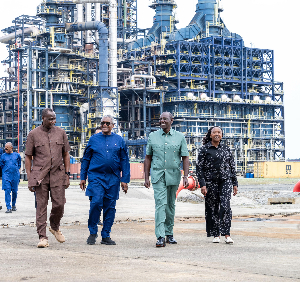 Kenyan President William Ruto (R) with Dangote Group CEO, Aliko Dangote (L)