Business News of Tuesday, 29 September 2026
Source: www.legit.ng
Naira escapes list of Africa’s 10 weakest currencies in September 2026

Nigeria’s naira has stayed off the list of Africa’s 10 weakest currencies by nominal exchange rate in September 2026, even as several currencies across the continent continue to struggle against the US dollar.
The development offers a notable contrast for the Nigerian currency, which has faced significant depreciation and volatility in recent years following reforms in the foreign exchange market.
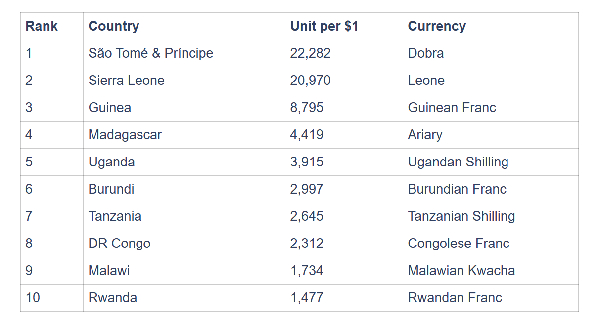
Data compiled from currency-conversion rates show that the São Tomé and Príncipe dobra, Sierra Leonean leone, Guinean franc and Malagasy ariary require some of the largest numbers of local currency units to purchase one US dollar.
The naira does not feature among the 10 currencies with the highest number of units per dollar in the September ranking. It is important, however, to note that a high numerical exchange rate does not by itself determine whether a currency is economically “weak.” Currency denominations, redenominations, inflation, monetary policy and exchange-rate regimes can significantly affect such comparisons.
Uganda, Ghana currencies face pressure
Currency pressures remain a concern across several African economies as businesses and consumers contend with demand for foreign exchange.
Uganda's shilling came under pressure in September, with commercial banks quoting the currency at around 3,915 to 3,925 per dollar on September 24.
Reuters reported that demand for dollars from energy importers, manufacturers and other businesses was weighing on the currency.
Ghana's cedi has also faced pressure. Reuters reported that the currency traded around GH¢11.50 per dollar on September 17, up from about GH¢11.45 a week earlier.
Demand for foreign currency from the energy and services sectors reportedly exceeded available supply, although gold-related inflows and central bank intervention provided some support.
Why weaker exchange rates matter
Sustained currency depreciation can have consequences beyond the foreign-exchange market, particularly for economies heavily dependent on imported goods.
A weaker local currency increases what businesses need to pay for machinery, raw materials, and other imports priced in dollars.
For households, the pressure can eventually show up in the prices of imported food, fuel, electronics and other consumer products.
It can also raise the local-currency cost of servicing foreign-denominated debt.
Nigeria’s absence from the ranking does not necessarily mean the naira is stronger in purchasing-power terms than every currency listed. Instead, the table compares the nominal number of currency units required to purchase one dollar.
Still, the naira's exclusion provides a different picture from periods when Nigeria's currency depreciation dominated discussions about African foreign-exchange markets.
Forbes names Africa's 10 strongest currencies
Legit.ng earlier reported that A strong and stable currency remains one of the biggest indicators of an economy's resilience, helping to curb inflation, lower import costs, attract foreign investment and strengthen consumer purchasing power.
Against a backdrop of global economic uncertainty, Forbes has released its ranking of Africa's 10 strongest currencies for July 2026.