Farouk Ahmed, the chief executive officer of the Nigerian Midstream and Downstream Petroleum Regulatory Authority (NMDPRA), said a statement circulating in his name, responding to recent allegations by Aliko Dangote, president and chief executive of Dangote Industries Limited, did not emanate from him.
Mr Ahmed, in a disclaimer sent to PREMIUM TIMES early on Wednesday, explained that while he is aware of the “wild and spurious allegations” made against him and his family and the frenzy it has generated, he has chosen not to engage in public brickbat.
He said he is thankful that the person behind the allegations has taken it to a formal investigative institution, adding that he believes that would provide an opportunity to dispassionately distill the issues and clear his name.
“My attention has been drawn to a purported response I was said to have made on the recent allegations against my person. I hereby state categorically that the so-called statement did not emanate from me.
“While I am aware of the wild and spurious allegations made against me and my family and the frenzy it has generated, as a regulator of a sensitive industry, I have opted not to engage in public brickbat.
“Thankfully, the person behind the allegations has taken it to a formal investigative institution. I believe that would provide an opportunity to dispassionately distill the issues and to clear my name,” Mr Ahmed said.
The allegations
On Sunday, Mr Dangote accused Mr Ahmed of economic sabotage, which he said is undermining domestic refining in Nigeria.
Speaking at a press conference at the Dangote Petroleum Refinery, he accused the leadership of the NMDPRA of colluding with international traders and oil importers to frustrate local refining through the continued issuance of import licences for petroleum products.
Mr Dangote claimed that Mr Ahmed was living beyond his legitimate means, adding that four of his children attend secondary schools in Switzerland at costs running into several million of dollars. He said such expenditure raised serious questions about potential conflict of interest and the integrity of regulatory oversight in the downstream petroleum sector.
On Monday, he expanded his allegations, accusing Mr Ahmed of corruption and misappropriation of public funds, and providing estimated figures for his children’s education abroad.
According to him, Mr Ahmed spent about $5 million on secondary education and upkeep over six years, and an additional $2 million on tertiary education, including $210,000 for Faisal Farouk’s 2025 Harvard MBA.
On Tuesday, Mr Dangote submitted a petition to the anti-graft agency, ICPC, through his lawyer, Ogwu Onoja, a Senior Advocate of Nigeria (SAN), calling for Mr Farouk’s arrest, investigation, and prosecution for allegedly living above his means as a public officer.
The petition, addressed to the Independent Corrupt Practices and Other Related Offences Commission (ICPC) Chairman Musa Aliyu, alleged that Mr Ahmed “spent without evidence of lawful means of income amounting to over $7 million for the education of his four children” in Switzerland. It provided the children’s names, schools, and specific amounts for verification.
Mr Dangote further accused Mr Ahmed of using his position to embezzle public funds, prompting protests from civil society groups.
He cited section 19 of the ICPC Act, which empowers the commission to investigate and prosecute corrupt practices, noting that a successful prosecution could result in a five-year jail term without an option of fine.
He urged the ICPC to act decisively, stressing that he remained available to provide evidence supporting his claims.
General News of Wednesday, 17 December 2025
Source: www.premiumtimes.com
NMDPRA’s CEO disowns ‘response’ to Dangote allegations, clarifies position
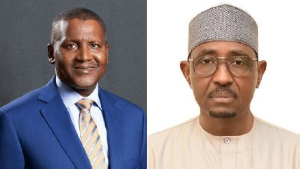 Aliko Dangote and Farouk Ahmed






Opinions