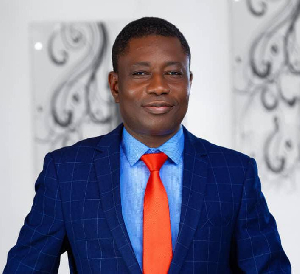
Nigeria's Ambassador-designate to Mexico, Reno Omokri, has revealed that he's the reason people call President Goodluck Jonathan "GEJ".
According to him, the idea to give Jonathan that acronym came when he was to be sworn in as President on Thursday, May 6, 2010.
Omokri stated that before the idea, Jonathan was simply known by Nigerians as Goodluck Jonathan.
"But all that changed in September when he started communicating directly with Nigerians via Facebook. I opened President Jonathan's Facebook page. And when President Jonathan's Facebook page was to be opened, his then-handlers preferred 'Goodluck Jonathan' as the moniker," he shared on Facebook.
"I insisted that the name Goodluck Jonathan would not achieve what we wanted it to if we did not add a Nigerian-origin name.
Then the name Azikiwe was suggested from his other names, and I objected, because I knew even then that he was going to contest. I said that the public had a tendency to call well-loved leaders by their initials, and GAJ sounded too much like GAG, and I did not want the Nigerian public to have it in their subconscious that the President, if reelected, was going to gag them. I know too well how the human psyche works subliminally.
"And then I was told that Ebele was also his name, but was not in wide usage. And that was how I seized on that name, and the President began signing his Facebook messages as GEJ.
"It was from that date in September, 2010 that the Nigerian public began calling him GEJ.
And because we did not use the full form of the name, even his fellow Izon people assumed it was a common Ijaw name, Ebelemi, shortened to Ebele.
"Actually, the full form of the Ebele used in GEJ is Ebelechukwu! And that is the name I gave to my daughter, because, in a sense, I brought that name to limelight.
"And no, President Goodluck Jonathan is not Igbo. Dr Goodluck Jonathan was born on November 20, 1957, in what was then Eastern Nigeria, and, for reasons I will not reveal here, many non-Igbo parents from the Eastern Region of Nigeria chose to give their children a token Igbo name.
"The point I am making is that if you walk around with two European or Arabic names, you may have a name, but you do not have an identity!
"Learn from former President Ibrahim Badamasi Babangida. I read his book, A Journey In Service, when it came out. General Babangida was not born as Ibrahim Badamasi Babangida. His birth name was Ibrahim Badamasi.
"But the name Badamasi is Arabic. It originates from the Arabic noun al-Badamasi, meaning a person from Damascus. In the Arab world, and in French, Damascus is known as Damas.
"Knowing this and to centre himself as a Nigerian, Mr Ibrahim Badamasi added his grandfather's name, Babangida, as his official surname.
"For those who do not know, Babangida is a wholly Nigerian name without ANY foreign influence!
"As a people, we should realise that nobody has the obligation to preserve our culture but us. If we walk around telling people our name is William Benson or Yusuf Isa, what we are actually telling the world is that we prefer a foreign culture to our own indigenous heritage, and that will make the world treat us like a vulture.
"And you do not need to change your name to fit into Western society. Look at the most successful Nigerians in the West. They kept their African names.
"In terms of national politics in the Western Hemisphere, the most influential Nigerians are Wale Adeyemo, who was Deputy Secretary of the Treasury in the cabinet of President Joe Biden, and Kemi Badenoch, who was almost Prime Minister of the United Kingdom, and then became that country’s Secretary of State for International Trade of United Kingdom, and is now the official leader of His Majesty's opposition in the United Kingdom.
"The first Black African Nobel laureate for an academic category (Professor Wole Soyinka), and the first Nigerian to win a Grammy Award (Sade Adu), as well as the first person born and bred in Africa to have won a Pulitzer Prize (Dele Olojede), all did so with their Nigerian names.
"Finally, the most prolific and successful novelist from Nigeria today gave up her European name, Amanda, and adopted a never-before-used but now popular Igbo name, Chimamanda Ngozi Adichie.
"Whether in Nigeria or abroad, your indigenous Black African name will work better for you!"
General News of Tuesday, 4 August 2026
Source: www.mynigeria.com
How I made Nigerians to start calling Goodluck Jonathan GEJ
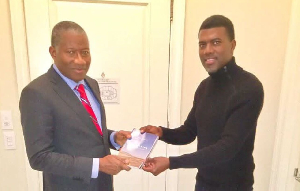 Goodluck Jonathan and Reno Omokri





Opinions