More evidence keeps emerging that Yoruba women in West Africa originated the voluminous headtie called Gele, which is now going international, as adorned by singers Beyoncé and Rihanna.
MyNigeria has come across evidence from history amid claims from Igbo youths on social media that their ethnic group owns Gele. According to the Igbo youths, what Yoruba people call Gele is Ichafu in their language.
However, records show that Ichafu is a corruption of the French word Chiffon, a soft scarf that is no more than one yard. Historical records and photos also show that Ichafu differs from Gele, which requires more than 2 yards of material, making it elaborate and towering. Records by White historians in the colonial era also show that Igbo women began wearing Gele when they came in contact with Yoruba women.
The latest evidence seen by MyNigeria was published in 1974 by an American newspaper The Evening Independent, which documented the Gele, describing the Yoruba headdress worn by women in Ghana, Nigeria, Togo and Dahomey. The article notes that basic Gele requires 2+ yards of fabric and details different wrapping techniques.
Read below
Fashion ties up loose ends
There are several ways to keep a cool head in the hot sun. Cornrowing, or braiding your hair in rows, which was discussed a few weeks ago in The Scene, is one of them. Another is by wrapping your head in a gele.
Geles (pronounced GAY-lay) are African head dresses commonly worn by women in Ghana, Nigeria, Togo and Dahomey.
While there are many different ways to tie a gele, the basic gele runs from 2½ yards or more in length, depending on how full you want it.
According to a diagram in Black News magazine, you start by folding your cloth in thirds lengthwise so the selvages lap slightly. Then you hold your cloth at one end lengthwise in front of your face and place this end to the rear of the left side of your head.
Holding it in place with your left hand bring the rest of the cloth down across your forehead and over your right ear with your right hand. Then bring the cloth around the back of your head meeting your left hand.
Keep your right hand on your head holding what you’ve already wrapped, and, taking the rest of the cloth in your left hand bring it over your left ear and across the front of your head (pull to tighten slightly) and around to the back.
You then take the cloth in your left hand, bringing it around the front above the first layer and across to the right side using both hands to spread the cloth in preparation for the second layer fold.
Holding the rest of the cloth at the top with your right hand let the bottom hang free. Place your left hand on your forehead and fold the cloth in your right hand over it. Slip the left hand out and grab the rest of the cloth with both hands arranging the folds neatly over the right side of your head.
Continue to wrap the cloth around your head clockwise until you reach the end (which should come to the back) and with the left hand find the closest layer and tuck the end in securely with your right hand. Shake your head a few times to make sure it’s secure, or hold the end in place with a safety pin.
If that sounds complicated, here is a simpler gele based on designs from Essence, a black women’s magazine:
To fashion a coiled gele, begin with three yards of 44 or 45 inch wide fabric. Fold it in half lengthwise, center the fabric on your forehead, letting the ends hang free, and tie the ends in a knot on the back of your neck, as you would a scarf.
Twist the ends into tight coils. Bring one end around the top of the head and tuck it in at the side. Circle the other coiled end around itself to make a chignon.
A gele can be worn just about anywhere, and looks especially good with a long, wrap-around dress of matching material. To make a simple wrap-around dress, use six yards of material if you’re a size eight to 10, or seven yards of 60 inch material if you’re a size 12 to 14, depending on your height and the stretchability of your fabric.
Fold the top selvage over approximately one inch. Hold the material in front of you. Place the first end at the right hip, bring the material around to the front of your body below the bodice. Tie and knot the ends together at the right hip. Arrange the tie to get loosely gathered and “puffed” effect. The bodice should be high, the back low.
With practice, you can create all kinds of variations of the gele and body-wraps.
ASA
General News of Wednesday, 14 October 2026
Source: www.mynigeria.com
Evidence from 1974 American newspaper proves Yoruba own elaborate headtie called Gele
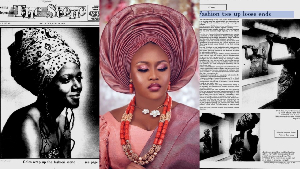 Pages from The Evening Independent/Woman on Gele headtie